
A downtown that exists for July is a set. A downtown that exists in October is a town. The difference is visible from the sidewalk: which rooms are lit, which chairs are still out, which door opens for a person who lives three blocks away.
Early October is the month when that difference becomes obvious in Michigan. The summer street furniture is still up in some towns and already stacked in others. A chair outside does not mean the room behind it is open for a resident on a Wednesday. Hours do. Travel coverage usually stops at the recommendation. Community coverage starts with the hours.
A bookstore that closes at four cannot be the reason to stay. A cafe that opens for the school run can. Those are types, not a claim about a named shop in a named town this Sunday. The test travels. Apply it to whatever main street you are actually on: would this block make sense in the third week of January?
The Mitten Daily treats main street as a beat, not a backdrop. The visitor is welcome. The resident is the source. A photograph of a hanging basket does not answer the beat. A posted hour, and a door that matches it, does.
After the season, walk one block and read the windows. If the only light is decorative, the downtown is between uses. If someone is inside doing the ordinary work of a weekday, the town is still there. That is the whole distinction, and October is when it is easiest to see.
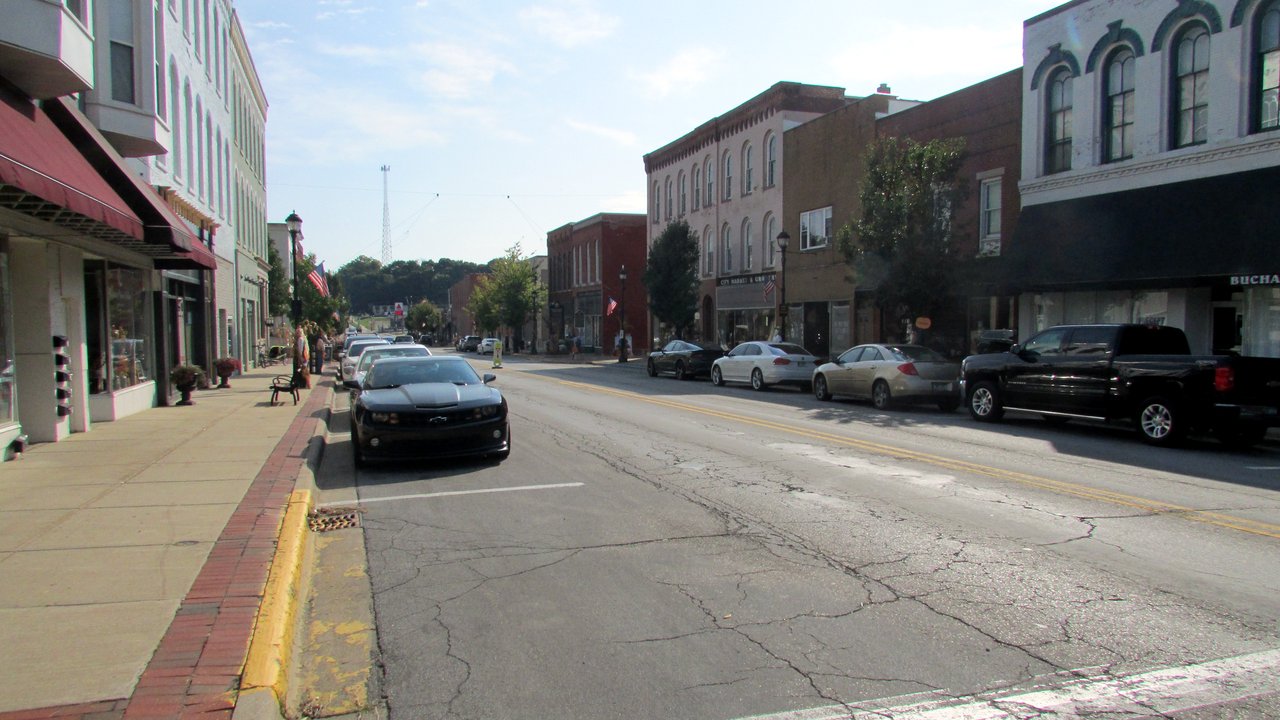
Updated Oct. 7, 2026: Replaced an AI-generated illustration with a licensed photograph of downtown Buchanan’s Front Street.
Sources:
Michigan Economic Development Corp., Michigan Main Street, “Frequently Asked Questions,” https://www.miplace.org/programs/michigan-main-street/faq/
Pure Michigan, “Fall in Michigan,” https://www.michigan.org/fall
Photo: Chris Light, “Main St 19-09-20 028,” Sept. 20, 2019, Wikimedia Commons, CC BY-SA 4.0 (https://creativecommons.org/licenses/by-sa/4.0/), cropped and color-corrected; derivative under the same ShareAlike license, https://commons.wikimedia.org/wiki/File:Main_St_19-09-20_028.jpg
