
Election 2026 · Lansing
Proposal 2 would bar campaign donations from Michigan’s regulated utilities and large government contractors
LANSING, Mich. — The second statewide question on Michigan’s Nov. 3 ballot would rewrite parts of the state’s campaign finance law, banning political contributions from regulated electric and gas utilities and from companies with large government contracts.
Proposal 2026-2 is an initiated law put on the ballot by Michiganders for Money Out of Politics, which also calls its campaign Mop Up Michigan. Co-chair Christy McGillivray has said more than 560,000 people signed petitions for it.
What it would do. According to the ballot summary and a Sept. 29 analysis by the nonpartisan Citizens Research Council of Michigan, the proposal would:
• Prohibit regulated electric and gas utilities, contractors with more than $250,000 a year in state or local government contracts, and people and organizations with substantial connections to them from contributing to candidates for, or holders of, offices that affect them.
• Extend donor and spending disclosure to political ads that clearly identify a candidate or ballot question, even when they avoid words like “vote for” or “vote against.” WDIV-TV reported the disclosure would apply to groups spending $5,000 or more on such ads within 100 days of a general election or 30 days of a primary.
• Expressly require “paid for by” disclosures on internet political ads.
The research council noted the proposal has a severability clause, so if a court struck one part, the rest would stand. Voters, though, decide the whole package with a single yes or no. If it fails, current law stays in place, and the Legislature could take up any of the issues later.
Supporters. “The entities giving millions and millions of dollars to politicians often get exactly what they want in policy, and the result is that the voices of voters are drowned out,” McGillivray told WDIV. She said the ban would curb the influence of utilities and government contractors.
Opponents. A committee formed to fight the measure, Protect MI Free Speech, argues it reaches too far. Spokesperson John Sellek told WDIV the proposal “would ban average citizens from supporting the candidate of their choice” because it covers people connected to utilities and contractors, could put nonprofit service groups’ funding at risk, and would be “found as an unconstitutional overreach on freedom of speech in the courts.” DTE referred the station to Sellek’s comments. Consumers Energy media relations director Katie Carey said the approach “won’t eliminate money in politics” but would “shift influence away from Michigan companies and toward wealthy national donors and special interests.”
The legal question. The research council, which does not take positions on ballot questions, said limits on political spending must clear a high bar under U.S. Supreme Court precedent and that the contribution bans are likely to be challenged in court. It also said it is not clear how much the disclosure rules would change the volume of such ads or how voters respond to them.
A WDIV/Detroit News poll that read likely voters the ballot language found 71.5% would vote yes, 15.6% no and 12.8% undecided or declining to answer, the station reported.
Monday, Oct. 19, was the last day to register to vote online or by mail. After that, residents can still register in person at their city or township clerk’s office with proof of residency, through 8 p.m. on Election Day. Statewide early in-person voting runs Oct. 24 through Nov. 1, and polls are open 7 a.m. to 8 p.m. on Tuesday, Nov. 3. Voters can check their registration and see their sample ballot at Michigan.gov/Vote.
Updated Oct. 20, 2026: The Oct. 19 deadline to register to vote online or by mail has passed, so the voting details now say so. Residents can still register in person at their city or township clerk’s office with proof of residency through 8 p.m. on Election Day.
Sources:
Citizens Research Council of Michigan, “Proposal 2026-02: Mop Up Michigan Initiative,” Sept. 29, 2026 (provisions, severability, if adopted/rejected, constitutional issues), https://crcmich.org/publications/proposal-2026-02-mop-up-michigan-initiative
WDIV-TV ClickOnDetroit, “Michigan Proposal 2 aims to limit corporate money in politics — supporters, opponents clash,” Oct. 16, 2026 (McGillivray, Sellek, DTE, Carey quotes; signatures; disclosure thresholds; poll), https://www.clickondetroit.com/news/local/2026/10/17/michigan-proposal-2-aims-to-limit-corporate-money-in-politics-supporters-opponents-clash/
WDIV-TV ClickOnDetroit, “What proposals will Macomb County voters see on the November ballot? Here’s the list,” Oct. 15, 2026 (ballot summary of Proposal 2026-2), https://www.clickondetroit.com/news/local/2026/10/15/what-proposals-will-macomb-county-voters-see-on-the-november-ballot-heres-the-list/
Michigan Department of State, “Absentee voting” and election calendar (registration, early voting and absentee deadlines), https://www.michigan.gov/sos/elections/voting/absentee-voting
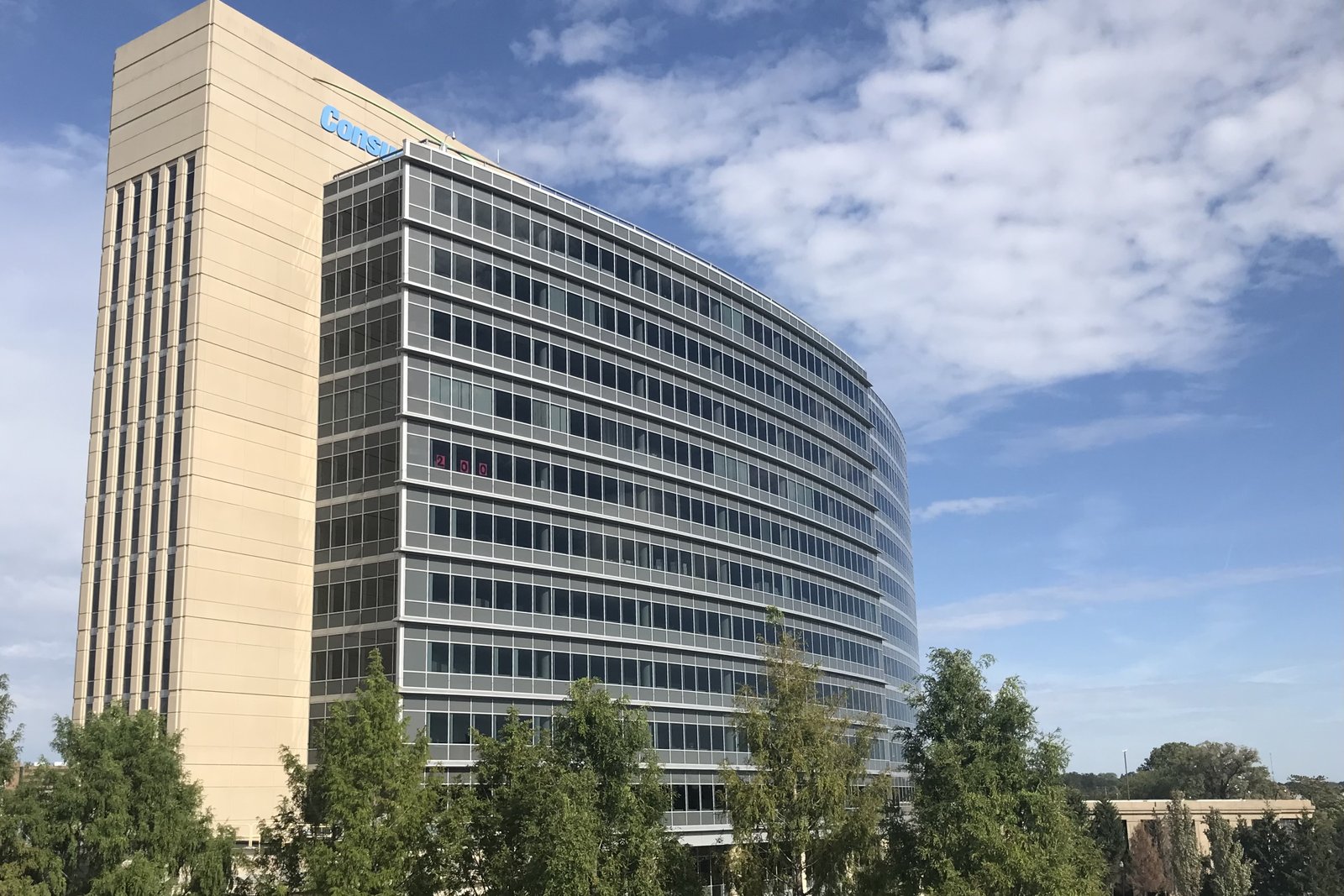
Photo: WeaponizingArchitecture, “Consumers Energy Headquarters, Jackson, Michigan.jpg,” Wikimedia Commons, CC BY-SA 4.0 (https://creativecommons.org/licenses/by-sa/4.0/), cropped; derivative under the same license, https://commons.wikimedia.org/wiki/File:Consumers_Energy_Headquarters,_Jackson,_Michigan.jpg

More from Lansing
Election 2026 · October 17, 2026
John James pitches an income tax cut and local say on data centers in his final debate with Jocelyn Benson
In Thursday’s final debate in Detroit, the Republican promised to cut Michigan’s 4.25% income tax “into the threes” and blamed eight years of Democratic control in Lansing. Benson, the Democrat, tied James to President Trump and touted a plan to lower health care costs.
Sports · October 17, 2026
Mid-Michigan, the Thumb and Blue Water Area: Week 8 football scores
Grand Ledge beat defending state champion DeWitt, Frankenmuth won a 15th straight TVC title, and Port Huron and Marine City reached 8-0. Verified Friday finals from Mid-Michigan, the Thumb and the Blue Water Area.
Election 2026 · October 17, 2026
Six candidates are on the ballot for two Michigan Supreme Court seats, but two of them could not take office if elected
Justices Megan Cavanagh and Noah Hood face judges Casandra Morse-Bills and Michael D. Warren Jr. The two U.S. Taxpayers Party nominees are not attorneys, which the constitution requires of justices.
Election 2026 · October 17, 2026
Proposal 1 asks Michigan voters whether to call a convention to rewrite the state constitution
The question goes on the ballot automatically every 16 years and was rejected in 1978, 1994 and 2010. A yes vote would mean electing 148 delegates in 2027; the Senate Fiscal Agency puts one cost estimate at about $10.2 million.